


Unlocking Creativity with Judy K: Discovering Endless Variations in Threading Techniques


Tablet weaving uses cards threaded with yarn to create intricate bands and ribbons.
Exploring the world of tablet weaving reveals a fascinating truth: a single threading pattern can lead to countless unique designs. This discovery became clear while HWSD Guild Life Member, Eva Ruzicka, was examining the work of “Judy K” on the Twisted Threads website. Judy's approach to weaving variations from one threading pattern sparked Eva's curiosity and inspired hands-on experimentation. This post shares insights into how small changes in card turning create diverse patterns, practical tips for trying these variations, and ideas for weaving workshops.
Understanding the Basics of Judy K’s Threading Variations
The way the cards are threaded and turned determines the final pattern. Judy K’s method focuses on a single threading pattern but explores how different sequences of card turns produce many distinct designs.

The key lies in the direction and number of turns:
Forward turns (F): Cards are turned a quarter turn away from the weaver.
Backward turns (B): Cards are turned a quarter turn back toward the weaver.
Judy K’s original sequence involves turning the cards forward four times, then backward four times. From there, variations come from mixing the number of forward and backward turns in different combinations.
Why Threading Direction Matters
On the Twisted Threads site, threading direction is shown with slant strokes:
A forward slash (/) means the card is threaded “S.”
A backslash (\) means the card is threaded “Z.”

Cards 1 through 7 are threaded “S,” and cards 8 through 14 are threaded “Z.” This threading direction affects how the threads twist when cards turn, creating the distinctive patterns.

The twist direction depends on both the threading and turning direction. This interaction is what gives tablet weaving its charm and complexity.
Starting Position and Orientation
One detail that can confuse weavers new to Twisted Threads patterns is card orientation. Most weavers face their cards to the right, but these patterns orient the “face” of the cards to the left. This difference affects how you start weaving.
Judy K’s variations begin with holes C-D on top of the cards, not the usual D-A. To achieve this, start by turning the cards a quarter turn backward toward you. This small adjustment sets the stage for the variations to unfold correctly.


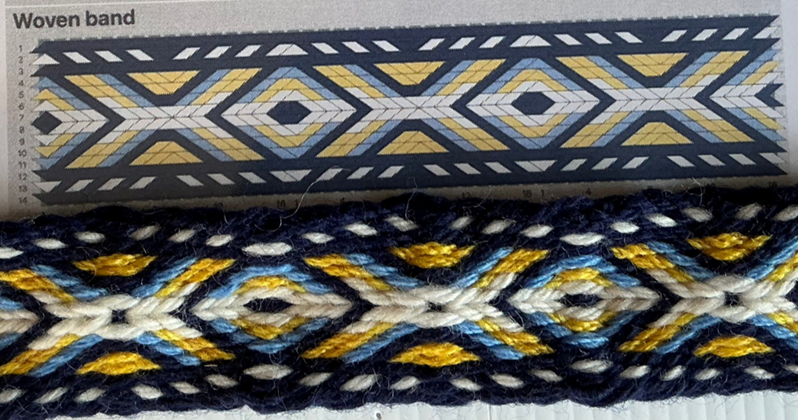
Exploring Variations Through Card Turning
Judy K’s approach shows how changing the number of forward and backward turns creates new designs from the same threading. Here are some examples:
F2 B2: Turning cards forward twice, then backward twice.
F3 B1: Turning cards forward three times, then backward once.
F4 B0: Turning cards forward four times with no backward turns.
Each sequence produces a different pattern, even though the threading remains constant. This means one threading can yield many distinct looks, expanding creative possibilities without needing to rethread cards.
Practical Tips for Trying Judy K’s Variations
If you want to experiment with these variations, here are some helpful pointers:
Keep notes: Record the number of forward and backward turns for each sample. This helps track which sequences produce your favorite patterns.
Use consistent tension: Uneven tension can distort patterns, so maintain steady yarn tension throughout weaving.
Start with simple sequences: Begin with balanced turns like F2 B2 before trying more complex variations.
Observe thread twist: Watch how the threads twist as you turn cards to understand how threading direction affects the pattern.
Adjust card orientation: Remember to start with holes C-D on top by turning cards a quarter turn backward before weaving.
Sharing and Teaching Through Workshops
The recent Annual General Meeting (AGM) provided a perfect opportunity to showcase these weaving samples and discuss future workshops. Tablet weaving workshops can help both beginners and experienced weavers explore threading variations and card turning techniques.
Workshops can cover:
Basics of threading and card orientation
Understanding S and Z threading directions
Practicing forward and backward turns
Creating samples with different turn sequences
Troubleshooting common weaving challenges
Hands-on learning helps weavers see firsthand how small changes affect patterns, encouraging experimentation and creativity.
Final Thoughts on Unlocking Creativity with One Threading
Judy K’s work demonstrates that creativity in tablet weaving doesn’t require endless new threadings. Instead, exploring how cards turn forward and backward opens a world of pattern possibilities from a single threading.
For weavers eager to expand their skills, trying these variations offers a practical way to discover new designs without extra setup. Whether you weave for fun, craft gifts, or teach others, understanding these techniques adds depth and excitement to your weaving journey.
Try experimenting with your own sequences of forward and backward turns. Share your results with fellow weavers or at local workshops. This approach turns a simple threading into a playground of creative potential.
All images of weaving samples provided by Eva Ruzicka.
Text by Eva Ruzicka and Bronwyn Platz.


Comments